
Orcas and the Public Relations Disaster of a Name
“Killer whale” is a strange name to pin on an animal that doesn’t kill people and isn’t a whale at all. The label sticks, though, and with it comes a mix of fear, fascination, and some very unhelpful assumptions.
Reportedly, 18th-century sailors witnessed orcas hunting large whales and called them “whale killers,” which later flipped into “killer whales,” branding them forever with this mistranslation and sensational shorthand. Not a minor slight for one of the most intelligent, socially complex, family-oriented animals on Earth.
“Killer whales” are indeed carnivores, so yes—they kill for food. At the top of the chain, in fact. But many experts and whale nerds like me prefer “orcas” (or orca, an equally valid plural), if only because it sidesteps the Jaws-esque image of massive, marauding machines just waiting to dig their forty-eight, three-inch-long teeth into human flesh.
To wade a little deeper, orcas are no more “killers” than any other carnivorous species, including humans (we don’t call ourselves “killer humans,” though the label seems more broadly applicable). And despite the name, they aren’t whales at all. They’re the largest members of the dolphin family. Hello, Flipper!
If we applied this naming logic consistently elsewhere, we might go around calling house cats “homicidal donkeys.” (I can’t tell whether my cat is impressed by that idea, deeply offended, or passing her usual idle judgement.)
Rest assured, orcas do not eat humans, and there is not one documented case of a wild orca killing a person. Ever. In fact, maintaining distance from orcas protects them far more than it protects us. Orcas rely on sound—echolocation—for communicating and foraging. Especially since sound travels faster in water than air, boat noise is highly disruptive. Further, acclimating orcas (or grey or humpback whales) to vessel proximity puts them at higher risk of injury or death from vessel strikes.
It turns out these “killers” need our protection. Notably, the Pacific Northwest’s Southern Resident Killer Whales are critically endangered, with only 73 remaining due to a combination of the lineage after effects of the captures in the 1970’s, pollution, vessel disturbance, and dwindling food supply (mostly Chinook salmon). In addition, oil and bitumen pipelines pose a risk of catastrophic spills which could push these beloved orcas into extinction.
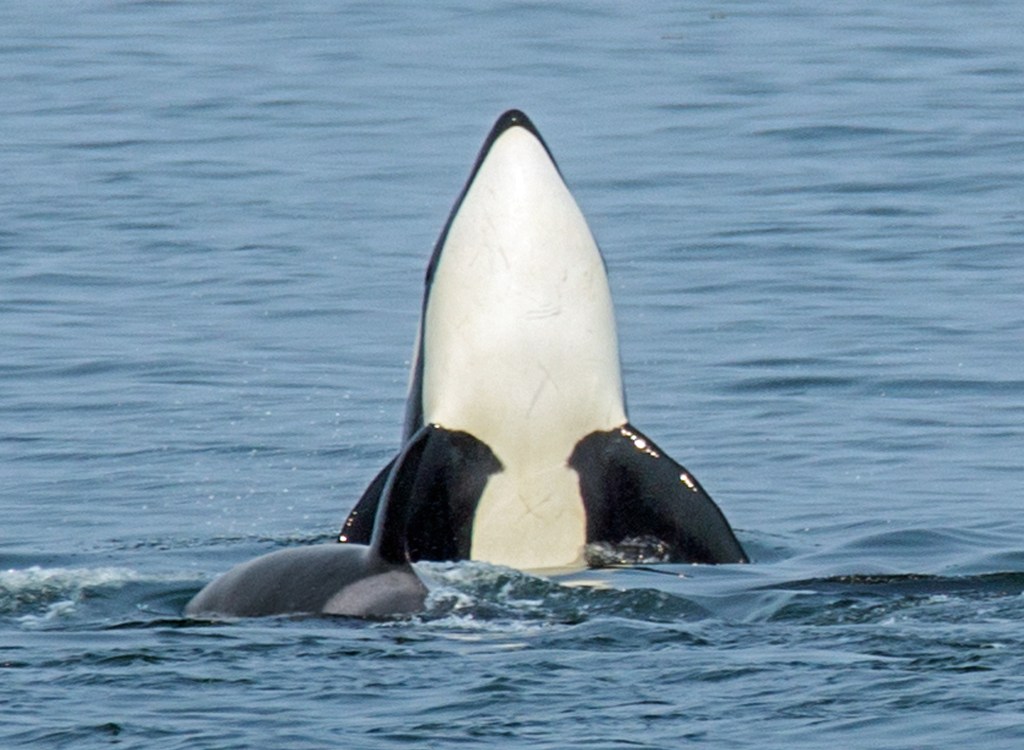
On the cheerier caricature extreme, spyhopping—as shown in the above photo—can look whimsical to us. My mind jumps straight to the jaunty Snoopy dance with his nose to the sky! This instinct to turn wild animals into characters or anthropomorphize their behaviors can overshadow both the science and the respect they deserve. Even calling these moments “a great show” echoes captive performance rather than wild behavior.
Fortunately, reverential distance doesn’t require detachment.
I recall the breezy, sunlit afternoon, perched on a lichen-bit rock when I took the above photograph near my home on the shores of Haro Strait. As opposed to chasing whales and orcas in tourist vessels, from shore you still get awe. Still feel connection. Still hear the wondrous blowhole exhalations. Your heart still trampolines against its cage when an adult male’s six-foot or calf’s tiny, curved dorsal fin slices the surface. And sometimes, without being invasive, you get to witness a close pass to shore that will make you forget how to breathe.
Maybe that’s why quiet encounters defy the mythology. As they simply pass by, orcas bear little resemblance to either Captain Ahab’s monster or a Free Willy plushie. The bona fide awe is simply in their existence. An animal to revere, not fear or dominate or call to perform.
A better media take? Orcas are magnificent, complex cetaceans just trying to survive on a human-infested planet.


 For the Orcas