
ENDANGERED ORCAS
Southern Resident Killer Whales
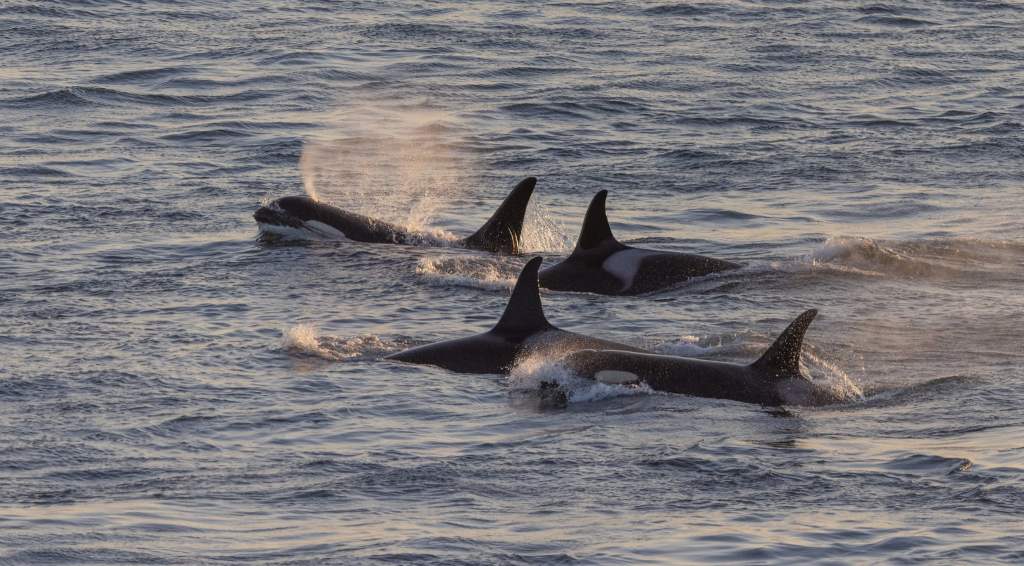
Photo Credit: Dante Aubert
The Pacific Northwest is home to an endangered ecotype of orca known as the Southern Resident killer whales (SRKWs).
Unlike Bigg’s (Transient) orcas, which hunt marine mammals, Southern Residents are exclusively fish-eaters. Their diet is dominated by salmon, primarily Chinook supplemented by chum and coho, with smaller amounts of sockeye, steelhead, rockfish, and herring [1]. An adult Southern Resident may consume 200–385 pounds (90–175 kg) of fish per day, making healthy salmon runs essential to their survival [2].
Southern Residents were officially listed as Endangered in 2005 under both the U.S. Endangered Species Act and Canada’s Species at Risk Act [3][4].
Population & Family Structure
As of 2026, only 75 individuals remain, divided among three pods: J, K, and L [5]. These whales live in tight-knit matrilines, multi-generation family groups led by mothers and grandmothers. Calves stay with their mothers for life. Knowledge about feeding grounds, travel routes, and salmon timing is passed down culturally across generations.
While Southern Residents may travel 80–160 km (50–100 miles) in a day, their movements largely follow salmon runs through the Salish Sea and surrounding coastal waters [6].
Even minor changes in births or deaths can significantly affect such a small population.
Births, Deaths & Survival
Long-term demographic monitoring shows that since 1990, 61 calves have survived beyond birth while more than 110 individuals have died or gone missing [5].
Calf survival remains a serious challenge. In some years, 40–50% of calves fail to reach adulthood, often linked to nutritional stress when salmon are scarce [7].
Southern Residents are also known for their strong social bonds. Several mothers have been documented carrying deceased calves for days or weeks — a form of epimeletic (care-giving or mourning) behavior observed in other cetaceans. In both 2018 and again in 2025, the orca known as J35 (“Tahlequah”) carried her dead newborn for extended periods, drawing worldwide attention to the fragility of this population [8].
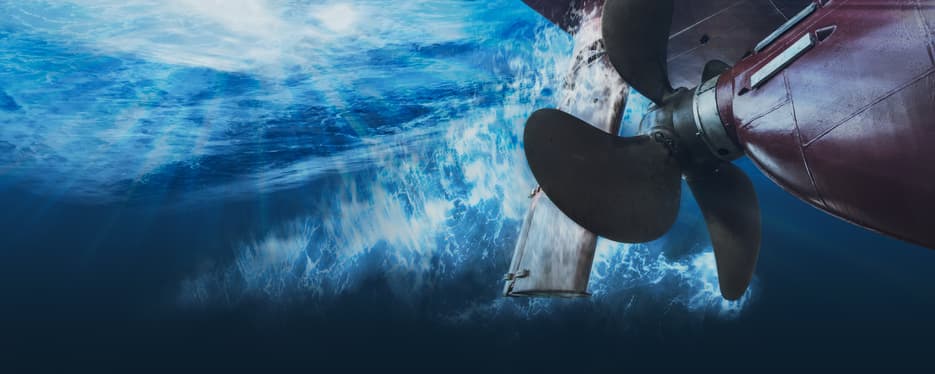
Photo credit: Stock photo
A History of Capture
During the 1960s and 1970s, at least 48 Southern Residents were removed or killed during live capture operations for marine parks [9]. Many of those whales would likely have become today’s matriarchs. Their loss created a lasting age gap that still affects the population’s resilience.
One of the most widely known individuals was Lolita (Tokitae / Sk’aliCh’elh-tenaut), captured in 1970 and held at the Miami Seaquarium for more than five decades. She died in 2023 within their tight, cement enclosure without ever returning to her home waters [10].
Why They’re Endangered
Marine traffic in Puget Sound and the Salish Sea has increased substantially in recent decades, elevating the risk of vessel collisions where shipping routes overlap critical whale habitat [11][12]. Vessel strikes are recognized globally as a significant cause of serious injury and mortality for large whales, including humpbacks and orcas [13][14].
In 2025, at least two high-profile vessel strikes involving humpback whales were reported in the Strait of Georgia region — one involving a high-speed passenger ferry and another involving a whale-watch vessel — resulting in serious injury or death to the whales involved [15].
While Southern Resident killer whales may be more visible due to their tendency to travel in larger social groups near shore, the risk of injury or death from vessel strikes remains for any whale when marine traffic and animal movements overlap.
According to NOAA Fisheries, primary threats to Southern Residents also include [3]:
- Insufficient prey (especially Chinook salmon)
- Contaminants in prey and water
- Noise and disturbance from vessels
- Historic captures and removals
Southern Residents rely on echolocation to hunt. Vessel noise can mask their calls, making it harder to locate prey or communicate with pod members who may be spread out. Boats that crowd or cross their path also disrupt feeding and increase stress, which may reduce reproductive success and calf survival [16].
Because these threats compound one another, recovery requires addressing all of them together.
Conservation & Protection
Both the United States and Canada have implemented recovery plans that focus on:
- restoring salmon habitat
- reducing underwater noise
- limiting vessel disturbance
- cleaning contaminated sites
- preventing oil spills
- protecting critical habitat
Canada has also implemented seasonal fishing closures in key foraging areas to preserve salmon for the whales [17].
URGENT: Canada’s new Pacific Link pipeline severely threatens to undermine all of these measures and potentially fast-track the extinction of SRKWs [18].
Protecting Our Resident Orcas
Quiet shore viewing is the only guaranteed zero-impact way to observe these orcas. All of our Southern Resident orca photographs were taken from land to ensure we never disrupt their natural behaviours.
While vessel distance regulations have recently been increased to 1,000m, this is a wolf in sheep’s clothing because tour vessels are now allowed to follow and observe them, whereas previously they could not. At 1,000m, vessel noise (especially the larger tour boats) is still loud enough to interfere with echolocation.
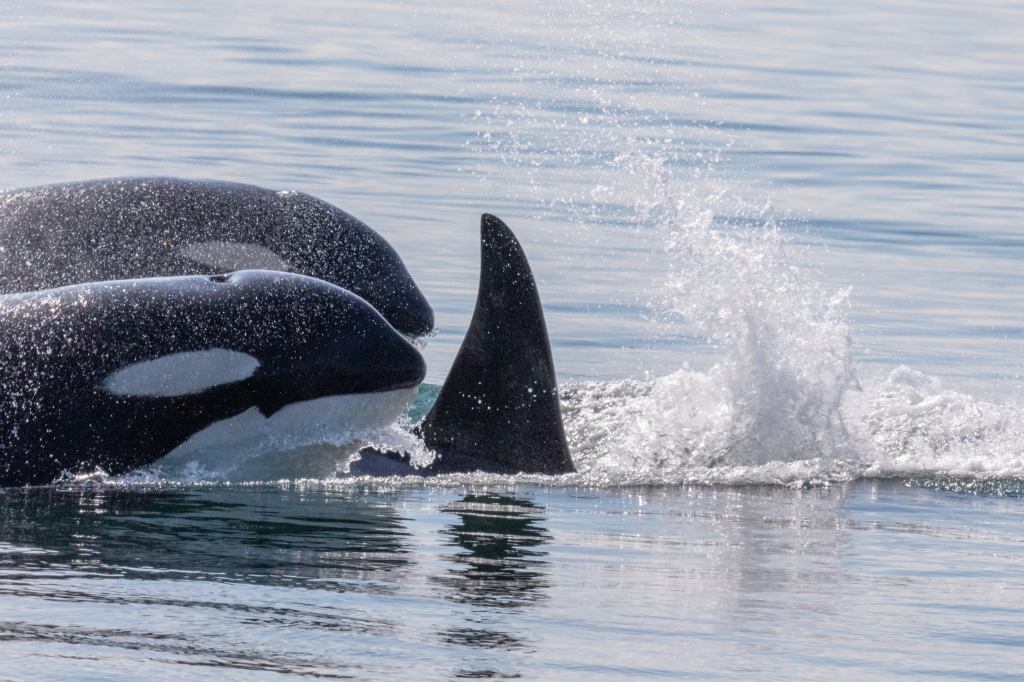
Photo Credit: Dante Aubert
What can you do?
- URGENT: Push back against Canada’s new $44 billion Pacific Link Pipeline. As of October 1, 2026 Canada’s federal government lead by Mark Carney (who has already rolled back key federal climate policies while fast-tracking major energy and resource projects) has been spun as a “national project of interest,” even though it poses high risk of SRKW extinction.
- Directly support organizations working on salmon restoration and orca conservation OR purchase one of our prints [here], whereby 100% of the profits goes to our selected advocacy groups.
- Avoid fishing for or purchasing Chinook salmon.
- Advocate for strong habitat protections and science-based policy.
- If boating, beyond adhering to regulations, slow down and move away from orcas (and all whales) to give them space to choose their path.
- Join social media or neighbourhood networks with others who share tips for sightings and a passion for shore viewing and/or commit on your own to a land-based practice.
- Don’t be fooled by the new 1,000m distance regulation. Advocate for NO vessel observation or following of SRKWs.
Every small action adds up. These families have called these waters home for thousands of years.
Only with care and commitment, Southern Resident killer whales
stand a chance of survival.
References
- Ford, J. K. B., Ellis, G. M., & Balcomb, K. C. (2000). Killer Whales: The Natural History and Genealogy of Orcinus orca in British Columbia and Washington State. UBC Press.
- Orca Conservancy. (n.d.). Southern Resident diet and energy needs.
- NOAA Fisheries. (2021). Species in the Spotlight: Southern Resident Killer Whale Priority Actions 2021–2025.
- Fisheries and Oceans Canada. (n.d.). Species at Risk Public Registry – Southern Resident Killer Whale.
- Center for Whale Research. (2025). Southern Resident census and demographic reports.
- Ford, J. K. B. et al. (2011). Travel and foraging ecology of resident killer whales. DFO Science Reports.
- Wasser, S. K. et al. (2017). Nutritional stress and reproductive failure in Southern Resident killer whales. PLOS ONE.
- NOAA Fisheries. (2025). Reports on J35 calf loss and maternal behavior observations.
- Olesiuk, P. F., Bigg, M. A., & Ellis, G. M. (1990). Life history and population dynamics of resident killer whales. International Whaling Commission Special Issue 12.
- Miami Seaquarium / historical capture records and obituary reporting (2023).
- National Oceanic and Atmospheric Administration Fisheries. (2021). Species in the spotlight: Southern Resident killer whale priority actions 2021–2025. U.S. Department of Commerce.
- Fisheries and Oceans Canada. (n.d.). Southern Resident killer whale: Recovery strategy and protection measures. Government of Canada.
- Laist, D. W., Knowlton, A. R., Mead, J. G., Collet, A. S., & Podesta, M. (2001). Collisions between ships and whales. Marine Mammal Science, 17(1), 35–75. https://doi.org/10.1111/j.1748-7692.2001.tb00980.x
- Van der Hoop, J. M., Vanderlaan, A. S. M., & Taggart, C. T. (2015). Vessel strikes to large whales before and after shipping lane reconfiguration. Conservation Biology, 29(2), 528–538. https://doi.org/10.1111/cobi.1239an der Hoop, J. M., Vanderlaan, A. S. M., & Taggart, C. T. (2015). Vessel strikes to large whales before and after shipping lane reconfiguration. Conservation Biology, 29(2), 528–538. https://doi.org/10.1111/cobi.12399
- Ocean Wise Conservation Association. (2025, November 3). When giants and ships collide: Why vessel strikes are rising and what we can do about it. Ocean Wise. https://ocean.org/blog/when-giants-and-ships-collide-why-vessel-strikes-are-rising-and-what-we-can-do-about-it/
- Holt, M. M., Noren, D. P., et al. (2009–2015). Vessel noise impacts on killer whale foraging behavior. Journal of the Acoustical Society of America.
- Fisheries and Oceans Canada. (2023–2025). Seasonal fisheries closures for SRKW foraging areas.
- Wilderness Committed. (2026, October 1). Canada’s most expensive extinction attempt now has a name: “Pacific Link Pipeline.” https://www.wildernesscommittee.org/news/canadas-most-expensive-extinction-attempt-now-has-name-pacific-link-pipeline


