
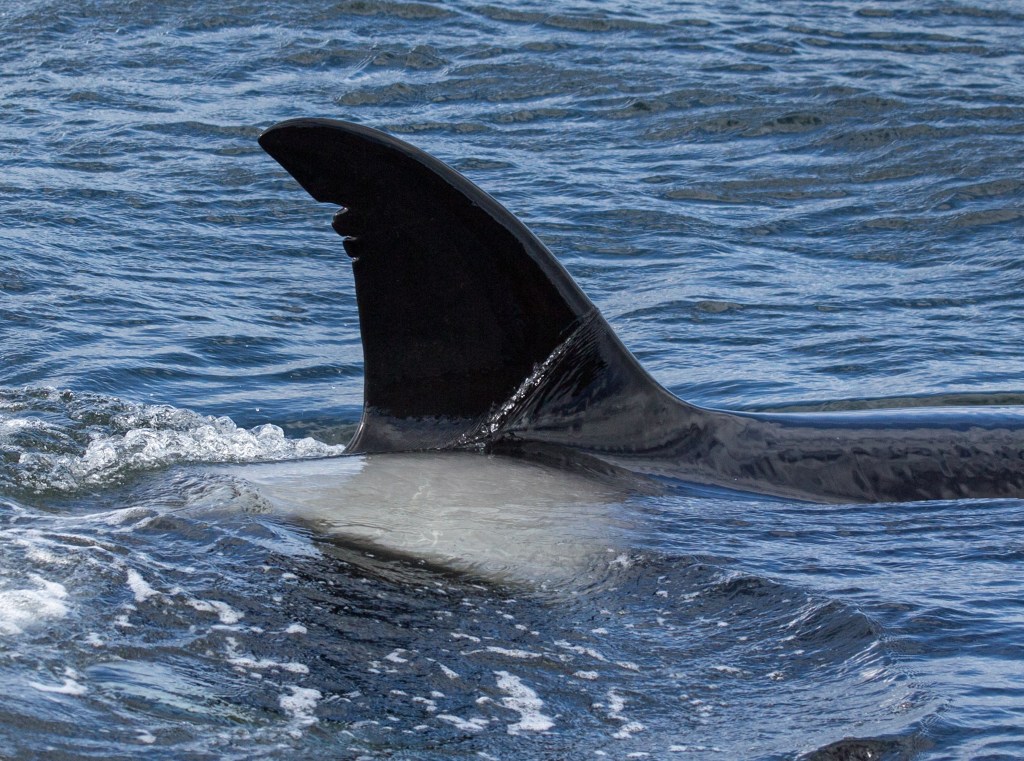
Did you know that individual killer whales can be identified by the shape and size of the dorsal fin, including distinctive nicks or scars along the fin’s trailing edge? Equally distinctive is the gray-and-white saddle patch located just behind the dorsal fin. Like a fingerprint!
Not only does this allow scientists to track individuals, monitor population health, and document family relationships, but learning to identify individual whales can also take your shore viewing experience to the next level.
In the waters of the Salish Sea, we have two ecotypes of orcas: Southern Residents (SRKWs) and Bigg’s (transient). While they are the same species, they differ markedly in appearance, behaviour, social structure, vocalizations, and diet. The SRKWs travel in larger, closely-related family groups and are fish-eaters (primarily Chinook salmon). Bigg’s orcas generally travel in smaller groups and hunt marine mammals such as seals, sea lions, and porpoises.
From a distance, it can be tough for non-experts to distinguish between Southern Resident and Bigg’s killer whales. Because the regulation distance for SRKWs is 1,000m, it’s always best to err on the safe side and keep your distance if you are aboard a water vessel. Sometimes the dorsal fin shape, group size and spacing, surfacing patterns, and hunting behaviours can be tell-tale signs.
Stellar news is that quiet observations from shore sometimes afford very close passes that would be illegal from a vessel. A snapshot of a fin and saddle patch can be cross-referenced to official catalogues to get an ID. (See here, for example.)
The above photo shows T063, better known as “Chainsaw” (or “Zorro” in Alaska). This 48-year-old Bigg’s orca is instantly recognizable by the deep, jagged notches in his six-foot dorsal fin, which resemble the teeth of . . . You guessed it!


 For the Orcas